044
- Filed
- 6 September 2026
- From
- El Nido · Remote
- Reading time
- 10 min
Deploying AI Agents in a Province with Unstable Internet
Our agents assume the connection will drop. Here’s the architecture that lets them queue, retry, and still hand every message to a human on time.

The first agent we deployed assumed it was always online. It answered beautifully — until a squall knocked out the uplink for forty minutes and nine guest messages sat unanswered, with no record of what had been promised.
§Design for the drop
- Every inbound message is written to a local queue first, then processed. If the uplink drops, nothing is lost.
- Agents never confirm a booking or a payment on their own. They draft; a human approves from their phone with one tap.
- Two uplinks: satellite as primary, a 4G router on a different network as failover. The switch is automatic and the agent doesn’t care which one it’s on.
- When both are down, the caretaker has a printed fallback: prices, availability rules and the boatman’s number.
- 14:02Satellite obstruction — heavy rain cell. Failover to 4G.
- 14:094G degraded. 3 messages queued.
- 14:44Uplink restored. Queue flushed: 9 replies sent, 2 flagged for human approval.
- 14:51Owner approved both from the back of a tricycle.
“An agent that can’t admit it’s offline is worse than no agent.”
§What the agents actually do
Mostly unglamorous work: answering “is there availability on the 14th?” at 11 p.m., collecting passport names for boat manifests, reminding guests that pickup time depends on the tide, chasing deposits politely. The value isn’t intelligence. It’s that nothing falls through the cracks while the humans are asleep, at sea or out of signal.
More stories
All stories
No. 047Field Ops
Building a Resort Without a Road
Every bag of cement, every solar panel, every nail came in on a bangka at high tide. Here’s what that does to a schedule, a budget, and the way you think about building.
11 min read · 27 Sept

No. 046Automation
Why Local Businesses Fail with Tech (and How We Fix It)
It’s almost never the software. It’s that nobody designed for a two-person business running on one shared Android phone and prepaid data.
8 min read · 20 Sept
No. 045Infrastructure
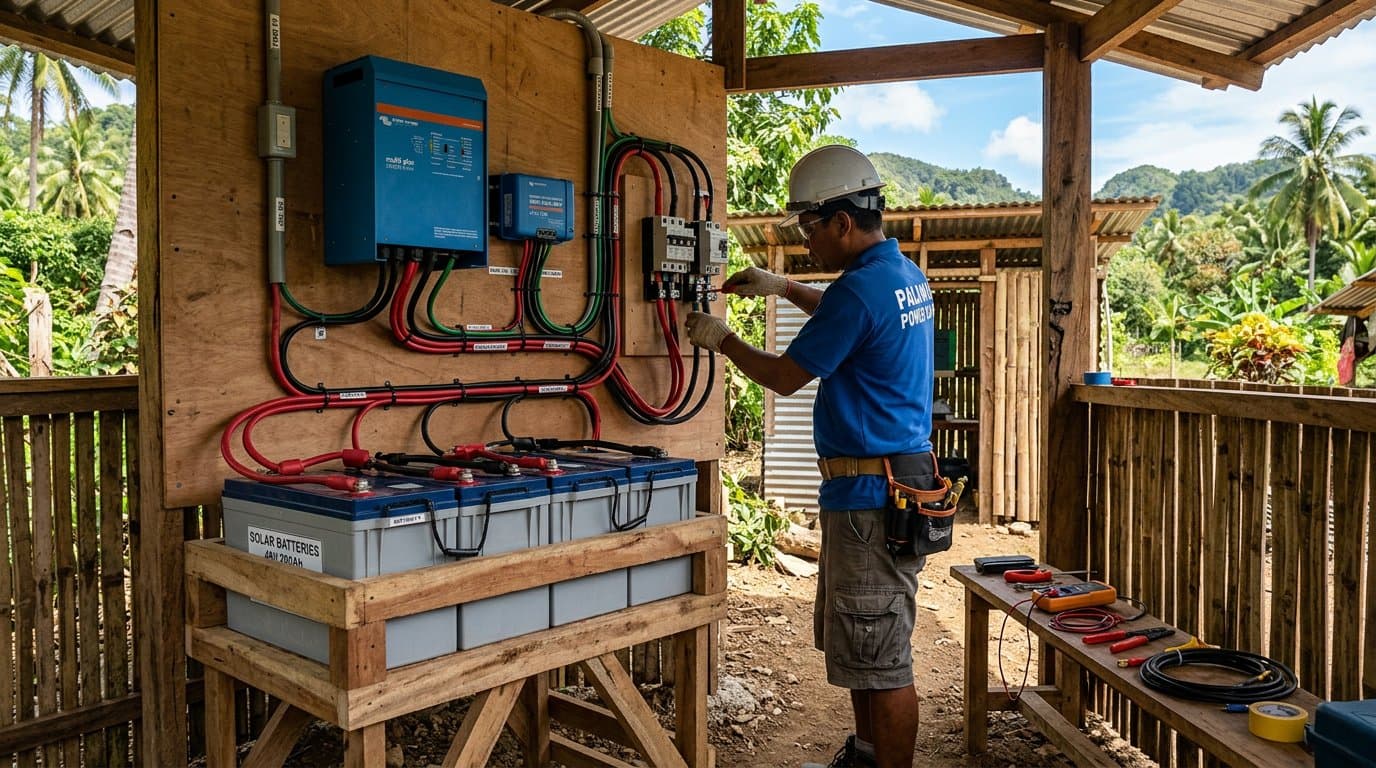
What Actually Breaks When You Go Off-Grid
Not the solar panels. A running list of the failures that actually took us offline — and the boring fixes that kept us online after.
9 min read · 13 Sept